

The King Edward is, of course, a famous variety and if you asked riders of the Clapham omnibus to name a potato variety the chances are they would name this one. These days they are far less likely to be eating them, however. Despite their commendable culinary attributes they are not a particularly high yielding potato so they are not the variety favoured by farmers. Or should I say supermarkets?
Most consumers will get their potatoes from the supermarket with whom farmers have contracts. The table below, published by AHDB (Agriculture and Horticulture Development Board), shows the top ten most widely planted potatoes in Great Britain in 2019. (It would be interesting to compare a similar list for amatuer and other small scale growers).
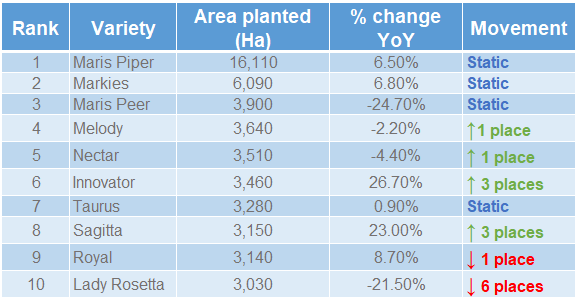
It seems odd that the once almost obiquitous King Edward is becoming a 'speciality' variety which, if you don't grow them yourself, you might have to search out.
Their kitchen-worthiness and their good storage charcteristics are reasons why I will grow King Edwards again this year. I normally grow at least one other maincrop and this year I will be growing one I've not tried before - Pink Gypsey - as well as Pink Fir Apple.
I'm always interested in the origins of notable fruit and vegetable varieties. If you had assumed that the King Edward, which dates from around 1902, was named after King Edward VII you would be correct. Royal approval for the name was sought and was forthcoming.
In the The History and Social Influence of the Potato by Redliffe N. Salaman (1949), the following information is provided about the origins of the King Edward:-
"The variety 'King Edward VII', whose parentage is unknown, was raised by a gardener in Northumberland who called his seedling 'Fellside Hero'. From Northumberland it passed into the possession of a grower in Snaith, Yorkshire, who brought it to the notice of a Manchester potato merchant. The latter could make no immediate use of it and gave his tubers to Mr J. Butler of Scotter [in Lincolnshire], who eventually bought all the stocks that were in the hands of the Yorkshire grower. Mr Butler grew on, until he had 50 acres of the variety in hand. On the advice of a Mr Paxton, potato merchant of Manchester, he rechristened the potato 'King Edward', and placed his stocks on the market in 1910 at £12.10s. a ton. This variety is to-day the most popular in England, and commands the highest prices on account of its excellent cooking qualities. This account, which I derived from Mr Butler himself, illustrates not only the spirit of the period then drawing to an end, but the fact that the producer of potato varieties is the last to reap any reward. Bred by an amatuer, chance dictated its birth, a native flair its survival, and the juggling of names its successful debut".
 |
| King Edwards with the characteristic red blush |





0 Yorumlar